

Rural Texas Does Not Need Another Committee. It Needs a Crowbar
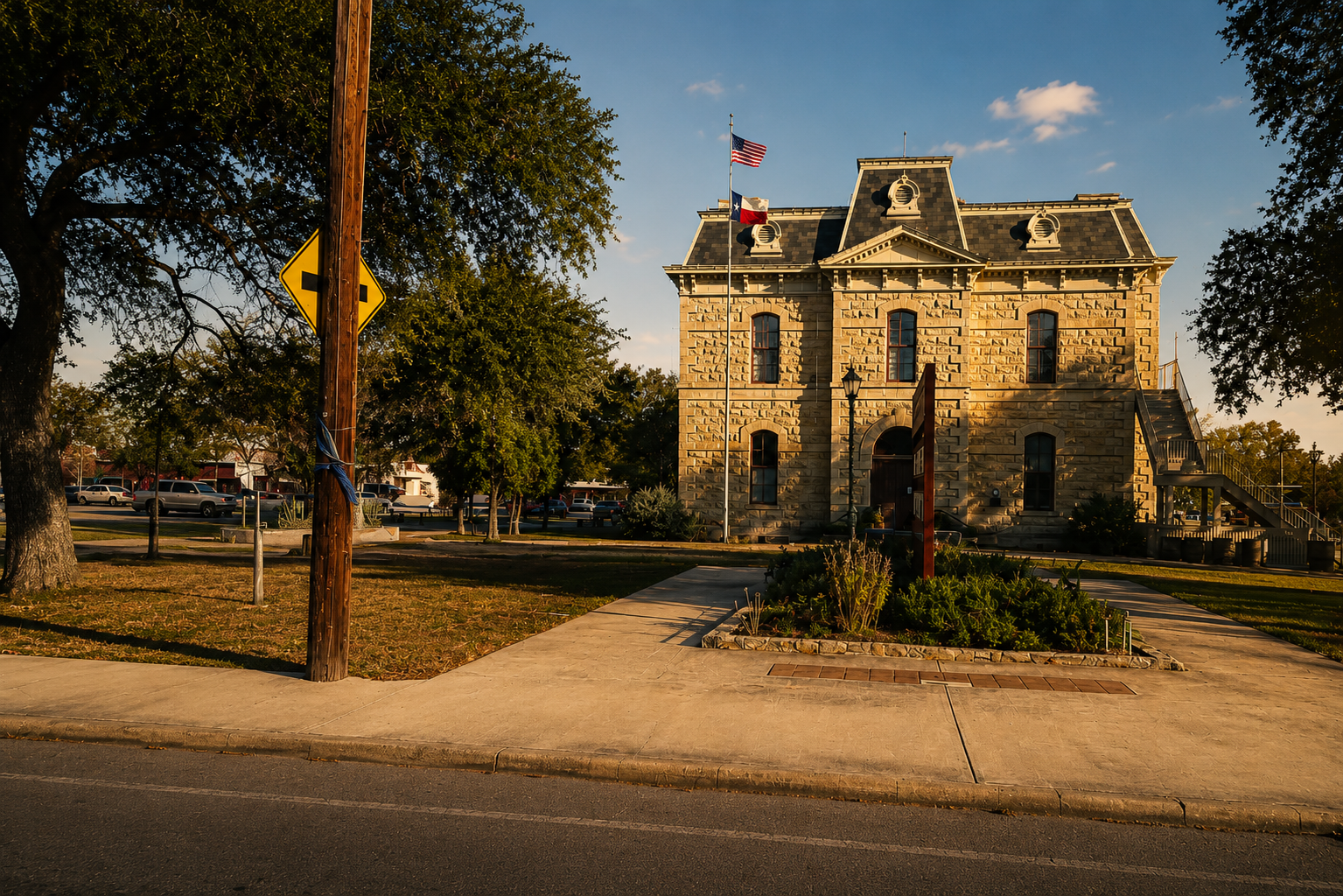
A rural Texas courthouse sits in the sun like a monument to what we inherited and what we still have to rebuild. If small towns are going to solve the upward mobility crisis, they do not need another roundtable. They need local power, working infrastructure, and the nerve to break systems that no longer serve the people living under them. (J. Matthew Pierce)
There is a strange and stubborn beauty in rural Texas. You can see it in the busted feed store sign that has somehow survived four governors, two recessions, a pandemic, and every consultant with a laminated badge who ever came to town promising “regional transformation.” You can see it in the football field lights on a Friday night, the courthouse square that still carries the bones of something once grand, and the old men drinking coffee at 6:15 in the morning like they are guarding the last known entrance to common sense. For all of this I am thankful for.
But beauty does not pay the light bill.
Rural communities are full of grit, memory, muscle, land, faith, family, and the kind of people who can fix a tractor with a crescent wrench, baling wire, and a vocabulary that would get you escorted out of a church picnic. What they are not full of, in too many cases, is upward mobility. Not the kind that looks good in a grant report. Not the kind where a kid gets a certificate, shakes a hand, takes a picture, and then leaves town forever because the nearest real job is 90 miles away and the Wi-Fi still behaves like it was installed by raccoons.
Texas likes to brag about size, and usually with good reason. But here is the part we do not talk about enough: Texas has the largest rural population of any state, with Texas 2036 reporting more than 4.7 million Texans living in rural areas. That is not some quaint leftover from the past. That is a state inside the state. That is more people than many governors ever have to govern.
And if we keep treating rural Texas like a museum exhibit with barbecue sauce, we are going to lose one of the most important engines of our future.
Matt Pierce YouTube video on the topic of small town growth and upward mobility.
The Upward Mobility Problem Is Not a Character Problem
Let us get one thing straight before the professional scolders arrive with their clipboard theology: rural poverty is not caused by laziness. Rural stagnation is not caused by people refusing to “just move where the jobs are.” That is the kind of advice you get from someone who thinks community is a networking event and family is a group text.
The upward mobility problem in rural communities is structural. It is about systems that were designed for population density, easy capital, large institutions, and places where opportunity sits close enough to hit with a thrown beer bottle.
In rural Texas, opportunity is often spread out like cattle across a dry pasture. You need transportation, broadband, health care, child care, workforce training, housing, local banking relationships, and schools that are not being asked to do miracles with duct tape and leftover state funding. When one of those pieces fails, the whole machine starts coughing black smoke.
Broadband is the cleanest example. More than 2.8 million Texas households and 7 million Texans lack broadband, according to reporting that cites U.S. Census Bureau data, and rural areas carry a disproportionate share of that burden. You cannot talk seriously about upward mobility in 2026 while pretending internet access is some luxury item for teenagers and Netflix addicts. Broadband is not entertainment infrastructure anymore. It is school, work, telemedicine, banking, entrepreneurship, job applications, public services, and the basic ability to compete.
A town without reliable broadband is not “preserving tradition.” It is being quietly handcuffed to the past while the rest of the economy leaves in a fast car.
Health Care Is Economic Development
There is another thing rural communities know too well: if the hospital closes, the town starts bleeding in ways that do not show up immediately on a balance sheet.
Texas 2036 reports that 74 Texas counties do not have a hospital, and at least 20 rural hospitals have closed since 2010. More than 100,000 Texans live in one of 32 counties with no primary care doctor. That is not just a health care issue. That is a workforce issue. That is a business recruitment issue. That is a young-family issue. That is a “why would a nurse, teacher, welder, entrepreneur, or expectant mother build a future here?” issue.
People do not build lives in places where basic care feels like a road trip. Employers do not relocate to counties where the emergency room is a rumor. Families do not stay where having a baby means calculating drive time like a military operation.
If rural Texas wants upward mobility, health care has to be treated like infrastructure. Not charity. Not a side conversation. Infrastructure.
Break the Systems, Not the People
When I say we need to break the systems, I do not mean burn the courthouse down, frighten the school board, or run around acting like a meth-addled Paul Revere. I mean we need to break the tired machinery that keeps producing the same busted outcomes while congratulating itself for “stakeholder engagement.”
Break the system that measures rural success by how many people leave and never come back.
Break the system that funds programs instead of outcomes.
Break the system that parachutes outside experts into small towns while ignoring the people who already know where the bodies are buried, politically speaking.
Break the system that treats broadband like a private convenience instead of a public economic necessity.
Break the system that tells young people they can either love their hometown or have a future, but not both.
Break the system that makes rural leaders beg for scraps from urban-centered policy tables, then thanks them for their “resilience” while handing them another unfunded mandate.
That word, resilience, has become dangerous. It sounds noble, and sometimes it is. But too often it is what powerful people say when they have no intention of fixing the thing that keeps punching you in the mouth.
Rural communities do not need more applause for surviving. They need tools to win.
The New Rural Growth Model
The old model said growth came from recruiting one big employer, cutting a ribbon, smiling for the paper, and praying the company did not leave when another county offered a sweeter tax deal.
That model is not dead, but it is not enough. Rural communities need a new growth model built around local ownership, regional cooperation, digital access, skilled trades, small business creation, land-based wealth, health care stability, and education that connects directly to real jobs.
The Dallas Fed has described digital access as a community development issue, noting that communities of all sizes are working to close the divide between those with reliable internet and those without it. That matters because the next rural economy will not be saved by nostalgia. It will be built by people who can sell online, learn online, diagnose online, organize online, and tell their own story online.
This is where the work of a Texas based journalist, rural communities public speaker, rural community thought leader, photographer, and Texas based storyteller matters. Not because titles are magic. They are not. Titles can be cheap perfume on a dead idea. But storytelling, real storytelling, can expose the rot and reveal the road forward.
A photographer can show what a spreadsheet hides.
A Texas based storyteller can make rural struggle visible without turning people into poverty mascots.
A rural communities public speaker can walk into rooms full of decision-makers and say, plainly, “You are solving the wrong damn problem.”
A rural community thought leader can connect the emotional truth of small-town life with the policy truth of what has to change.
And a Texas based journalist can keep asking the ugly questions after the press release has been printed and the politicians have gone back to Austin.
Rural Texas Has Assets. Stop Acting Like It Only Has Problems.
One of the dumbest habits in public policy is talking about rural communities like they are nothing but need. Need, need, need. Need money. Need access. Need doctors. Need jobs. Need training. True enough, in many cases. But rural Texas also has assets that urban planners would kill for if they could fit them inside a mixed-use development and charge $2,400 a month.
Rural communities have land. They have social trust, even when it is strained. They have local memory. They have churches, volunteer fire departments, school pride, agricultural knowledge, energy infrastructure, and people who still understand that civilization depends on work you can see with your hands.
The challenge is not that rural Texas lacks value. The challenge is that our systems are too stupid, too centralized, or too politically constipated to convert that value into upward mobility for the people who live there.
That means rural strategy has to move from extraction to ownership. If broadband gets built, train local people to install and maintain it. If renewable energy expands, make sure local tax bases, landowners, workers, and students benefit. If tourism grows, do not let outsiders own the story while locals clean the bathrooms. If state money arrives, demand measurable local capacity, not just another consultant report written in the bloodless dialect of bureaucratic fog.
The Goal Is Not to Save Rural Communities. It Is to Grow With Them.
“Saving rural America” is a phrase that ought to be handled carefully, preferably with gloves and a fire extinguisher. Rural people do not want to be saved by people who cannot find the county road without GPS and a panic attack.
The better mission is growing together.
Urban Texas needs rural Texas. It needs its water, food, energy, land, workforce, culture, and political stability. Rural Texas needs access to capital, markets, health systems, education pipelines, and technology. This should not be a hostage negotiation. It should be a partnership.
But partnership requires honesty. Some rural communities are stuck because old power structures like them that way. Some local leaders would rather manage decline than risk losing control in growth. Some state systems reward paperwork over courage. Some nonprofits confuse activity with progress. Some politicians show up for the photo and vanish before the hard vote.
That is why breaking systems matters. Not as a slogan. As a strategy.
Break the bottlenecks.
Break the permission culture.
Break the habit of waiting for Austin or Washington to notice.
Break the assumption that young people must leave to succeed.
Break the idea that rural communities are too small to matter when, in Texas, they are too important to ignore.
A Rural Future Worth Fighting For
There are some places in Texas where the sunset hits a cotton field or a two-lane road just right and you can feel the whole argument for staying. It is not sentimental. It is not soft. It is older and meaner and more honest than that.
People want roots. They want dignity. They want work that pays. They want their kids to have choices. They want a doctor within reach, internet that works, schools that can compete, and leaders who do not treat them like background scenery in somebody else’s campaign ad.
That is the upward mobility challenge in rural communities. It is not merely income. It is agency. It is whether people have the power to build a life without abandoning the place that built them.
So yes, we need to break the systems.
Break them open.
Break them apart.
Break them down to the studs and rebuild them with local hands, local knowledge, and enough political nerve to make the comfortable people nervous.
Because rural Texas is not dying. It is being underestimated. And underestimation has always been a dangerous game in this state.
Ask anybody who has ever bet against a small-town Texan with a long memory, a short fuse, and one good reason to keep fighting.