
The Moon Does Not Care Who You Pretend to Be
There is something unsettling about looking at the moon.
Not because it is mysterious.
Because it is indifferent.
Long before algorithms told us what mattered, before politicians told us who to hate, before social media convinced us that our value could be measured in followers and engagement, the moon simply watched.
Civilizations rose.
Empires collapsed.
People loved.
People lied.
The moon never applauded. It never condemned. It simply reflected whatever light reached it.
Maybe that is why I keep coming back to it.
Because somewhere along the way we stopped reflecting.
We started performing.
The modern world has become addicted to optimization.
Optimize your morning.
Optimize your productivity.
Optimize your content.
Optimize your relationships.
Optimize your attention.
Optimize yourself.
Everyone wants to become something.
Very few people stop long enough to ask whether the person they are becoming actually belongs to them.
Jordan Peterson often reminds us that meaning emerges from voluntarily confronting chaos.
Hunter S. Thompson would probably laugh, light another cigarette, and remind us that most people mistake the circus for reality.
I think both were pointing toward the same mountain from opposite sides.
The real battle has never been against chaos.
It has been against unconsciousness.
For the last several years I have been studying creators.
Not simply influencers.
Creators.
The people who wake up every morning and voluntarily place pieces of themselves into the world.
What fascinated me was never the platforms.
I actually dislike most platforms.
The interesting part has always been the psychology.
Why do some people continue creating while others disappear?
Why do some remain authentic while others slowly become manufactured versions of themselves?
Why do environments either nourish identity or slowly consume it?
Those questions eventually led me toward what I call Expressive Space.
The idea is surprisingly simple.
People flourish when they have enough psychological room to become themselves.
They decline when the environment rewards performance over authenticity.
That idea eventually escaped the creator economy.
Because it applies to all of us.
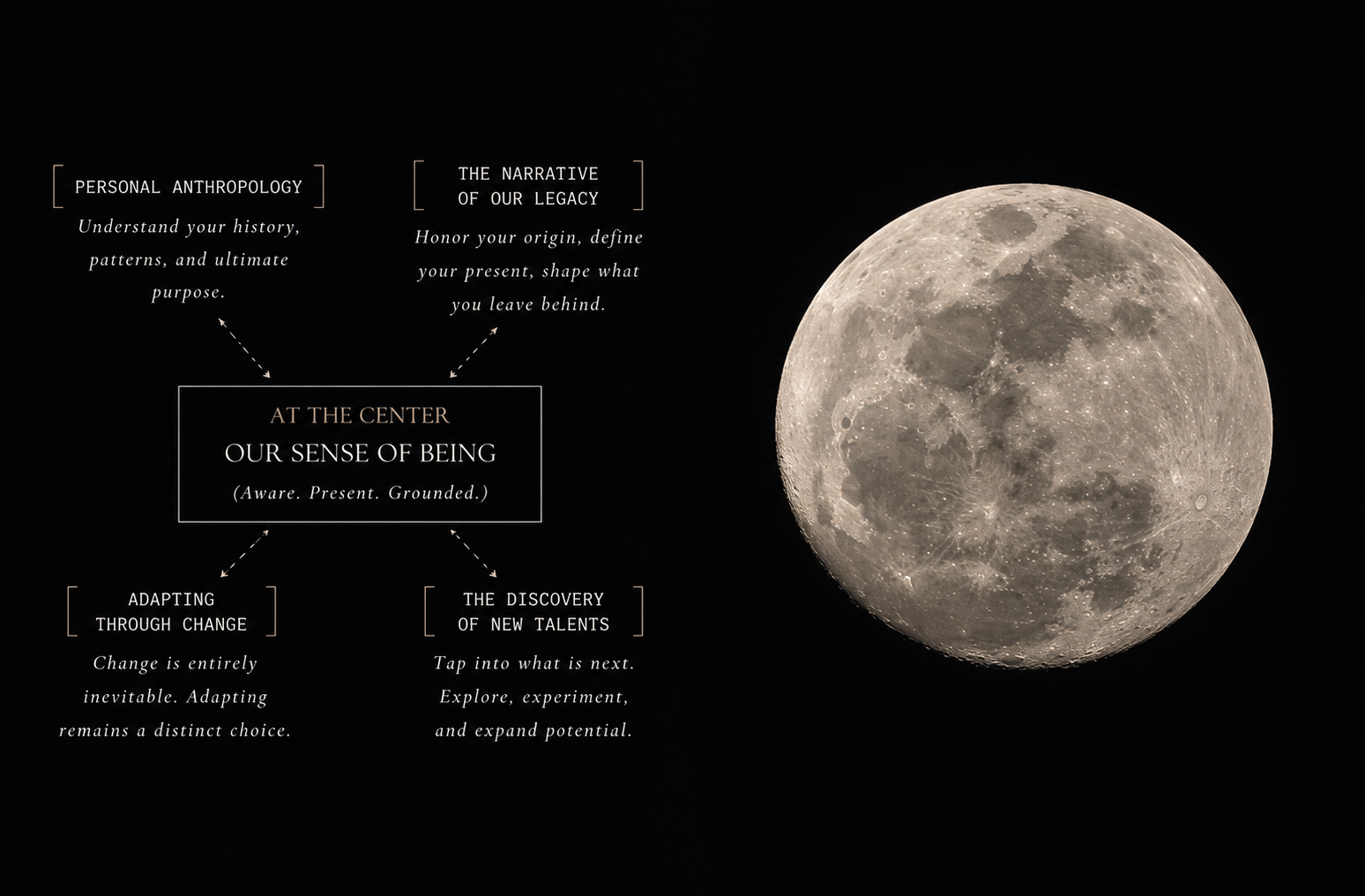
I have started calling this process Personal Anthropology.
Anthropologists spend their lives studying cultures.
Personal anthropology asks a different question.
What if you became the anthropologist of your own life?
Not to judge yourself.
To understand yourself.
Study your history.
Notice your recurring patterns.
Pay attention to the stories you inherited.
Separate what belongs to your family from what belongs to you.
Observe yourself with curiosity instead of condemnation.
Because buried inside your own history are the blueprints for your future.
Then comes something even harder.
The narrative of your legacy.
Most people think legacy begins when you die.
I think legacy begins the moment you decide who you refuse to become.
Every decision edits your autobiography.
Every compromise writes another sentence.
Every act of courage becomes another paragraph your children may someday inherit.
Legacy is not about monuments.
It is about trajectory.
Then there is adaptation.
Nature has always been my greatest teacher.
Nature does not reward the strongest.
It rewards those capable of responding to change.
I learned this growing up in South Texas.
I watched it while covering hurricanes.
I watched it in communities rebuilding after unimaginable loss.
People survive because they adapt.
But adaptation is not surrender.
There is a profound difference between changing your strategy and abandoning your identity.
One preserves your future.
The other sells it.
That distinction matters more than ever in a world constantly asking us to become someone easier to monetize. This conviction also echoes the broader direction of my research on community resilience and behavioral adaptation.
Finally, we discover new talents.
Not because they suddenly appear.
Because we finally become the kind of person capable of noticing them.
Potential is rarely hidden.
It is usually ignored.
Most people are carrying abilities they have never given themselves permission to develop.
They remain asleep because life keeps demanding efficiency instead of exploration.
At the center of all of this sits something I have simply called:
Our Sense of Being.
Aware.
Present.
Grounded.
Everything else revolves around that.
Not success.
Not status.
Not wealth.
Being.
Because when your sense of being is stable, life becomes far less interested in proving yourself and far more interested in discovering yourself.
The moon reminds me of this.
It does not chase attention.
It does not compete with the stars.
It does not apologize for its scars.
It simply occupies its place in the universe.
Maybe we should do the same.
Maybe the greatest adventure is not becoming someone new.
Maybe it is excavating the person who has been buried beneath expectations, fear, performance, and noise all along.
That is what Personal Anthropology is really about.
Not self-improvement.
Self-understanding.
Because the people who understand themselves eventually become impossible for the world to define for them.
And perhaps that is the beginning of freedom.
About the Author
J. Matthew Pierce (Matt) is a South Texas writer, behavioral researcher, and executive consultant exploring the intersection of psychology, leadership, and human behavior. Drawing from more than two decades as an international photojournalist covering natural disasters, conflict, community resilience, and human suffering, his work examines how people construct meaning, adapt to uncertainty, and build lives centered on authentic values rather than external expectations.
Matthew is the creator of Personal Anthropology, an emerging framework that helps individuals, executives, entrepreneurs, and organizations better understand the patterns that shape identity, leadership, and decision making. Rather than focusing solely on productivity or performance, Personal Anthropology encourages people to examine their personal history, core values, evolving narrative, adaptability, and untapped potential to create a life that is psychologically grounded and intentionally lived.
Based in South Texas and serving clients throughout San Antonio, the Texas Hill Country, and beyond, Matthew provides executive consulting, leadership development, behavioral strategy, and organizational guidance for professionals seeking greater clarity, resilience, and authentic influence. His work blends applied psychology, systems thinking, behavioral science, and real-world experience into practical conversations that help leaders navigate complexity without losing sight of who they are.
As an emerging scholar in applied psychology, Matthew's research explores expressive spaces, creator psychology, behavioral adaptation, organizational culture, and the psychological foundations of human flourishing. His long-term research agenda centers on understanding how people and communities build healthier lives through autonomy, meaning, and authentic human connection.
If you are searching for an executive consultant in South Texas, leadership consulting in San Antonio, or a fresh perspective on behavioral strategy and personal development, Matthew welcomes the opportunity to begin a meaningful conversation.